How To Teach Past Simple VS Present Perfect

It’s familiar to almost all of our students and offers practice of the grammar of future forms, conditionals and modals, all at once. The predictions are highly personalized, something to which students respond well, and the exercises can be integrated, with speaking, listening, reading and writing all combining into a seamless activity. Even those who dismiss palm reading, tarot and the other methods of predicting our futures seem to enjoy the process of creating a potential future for one of their classmates; imagination and creativity are brought in, and the students invariably learn something about each other, and perhaps about themselves.

Every culture in the world has some method of divining the future. Brainstorm these and compare them. What equipment is needed (cards, tea leaves, a crystal ball your palm)? Who might make the predictions (Romany women, soothsayers, fortune tellers, mystics)? What kind of predictions are normally made – are they about marriage, or work, or longevity?
To immediately begin using these words, hold a five-minute debate in pairs or small groups. Can such predictions be trusted? Do any of your students (or more likely, in my classes, their parents or grandparents) read horoscopes? Does anyone have experience of them coming true? If none of these classic methods are seen to be genuine, are there any other ways in which a person’s future might be foretold?
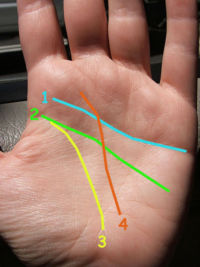
It makes a lot of sense, for the purposes of your class, to greatly simplify the process of palm reading. I’ve boiled it down to using only the left hand, and only four lines:
Have your students identify these lines on the left hand of their partner. It’s much more fun and interactive, as well as presenting a better practice opportunity, if your students are thinking not about themselves, and their own futures, but those of their neighbor.
 The language of shapes will become important; your students will need to be able to describe the exact shape and form of the lines. Elicit these with simple board drawings:
Curve, slope, swoop; circle, straight, wavy; broken, deep, shallow; separated, parallel
Ask your students to study the heart line and, either as a listening exercise or on a handout, provide these interpretative aids.
Now, the students should consider what this information may mean for their partner’s future. If they fall in love easily, does this mean they’ll make the wrong romantic choices? If they are in control of their emotions, does this imply they’ll avoid angry arguments? Invite them to begin building of a ‘picture’ of this person’s future.
Next comes the head line, with these hints.
Again, they should make predictions based on this new data. Does an adventuresome spirit mean a lot of foreign travel, or an enthusiasm for extreme sports? Does a short attention span imply a lack of academic achievement? Build these findings into the ‘picture’ and add detail to their predictions for the future.
These hints will help.
Add this data to what we can already predict. Does the hospitalization connect with their adventuresome lifestyle? If they’re both cautious in love, and realistic, will they wait a long while before choosing a partner?
In my experience, only around 5-10% of students have one of these. If they do, here are the hints:
Your students now have all the information they need to make a detailed prediction for their partner’s future. When might they marry, and with whom? What can we predict about work, family and travel? I’ve generally told the students that none of these lines can tell us how long we will live; this avoids the macabre prospect of warning a teenager that they may die in their thirties! Invite the students to indulge in as much detail as possible, using plenty of modal verbs (e.g. they might climb Mt. Everest; they could be an entrepreneur or a stockbroker) and conditional forms (e.g. ‘If they keep control of their emotions, they will be successful in business’).
These predictions are likely to cause quite a stir. How does the student react? Are any of these predictions particularly likely, or unlikely, to come true? Do they correspond to the student’s expectations for their own future? Can any of them be taken seriously?
It presents the chance for the class to unite around a common aim, to share elements of their own culture, and to use plenty of useful language.